Showing posts with label Art and Theology. Show all posts

Monday, November 29, 2010

How to write an artist statement that glorifies the Lord

How to write an artist statement that glorifies the Lord

The artist statement is a simple and brief summarization about your current body of artwork. It is intended to explain: why you make art, how you made it, what it is made out of and what art means to you.

How can you write about your artwork and glorify the Lord instead of yourself?

When asking yourself the above questions about your artwork, consider how you can give the Lord credit for your talent rather than yourself. Also, consider how the Lord is instrumental in helping you create. Finally, consider what art means to you in terms of glorifying the Lord. By writing your artist statement with these thoughts in mind, you will direct viewers to the original Creator. Which is why you create art any way isn’t it?

“In the same way, let your light shine before others, so that they may see your good works and give glory to your Father who is in heaven.” Matthew 5:16

Wednesday, May 19, 2010

Excerpt taken from: “In Defense of Christian Arts”

People of this world do not understand our Christian language. How can we speak to them in a way that they will understand? People of the world do not think it is necessary to believe. How can we get past their defenses to get to their hearts? The world, in trying to sell its philosophies understands one thing that we forgot. A person will not really believe something until it speaks to his feelings and his spirit.

The media uses what they know about how the mind works and the power of the arts, drama, photography, film, dance, story telling, etc. to speak to people and sell us whatever they want. This is a pity because the arts originally belonged to the people of God. Now they are seldom used and often categorized as superfluous or unnecessary. From stories of the son’s of Seth, to the portrayals of the prophets, to the dances of the Israelites, to the stories of the Rabbis, to the medieval Passion plays that portrayed Christ’s last days on earth, to film and story today, believers have always used the Arts, for worship, evangelism, teaching, enjoyment and exhortation. Why have so many churches thrown the gift of the creative arts back in the face of our Creator God? The only reason I can think of is fear.

Fear is never a good reason to make a decision. If the arts are corrupt in the world, then we need not to say the arts are corrupt. We need to bring them back to where they belong, in the holy service of Our King.”

Excerpt taken from:

“In Defense of Christian Arts”

Tuesday, May 18, 2010

Art Organization Link Added: The New Renaissance Rising

J. Scott McElroy, the author of the book "Finding Divine Inspiration" also has a website:
The New Renaissance Rising. It is a very informative website:

As noted on his website:

The resources, materials and ideas on this site are designed to Equip, Connect and Inspire artists and churches of all denominations for their place in God's renewal of the arts, and the art’s role in God's transformation and redemption of the world. This site features original information and also serves as a portal to other organizations who are pursuing God's heart for the arts and humanity.

Monday, April 5, 2010

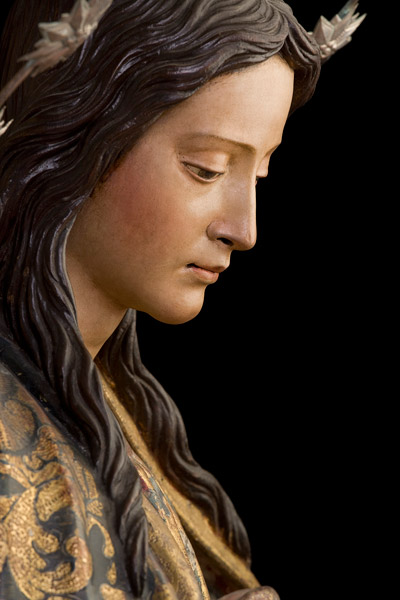
Spanish Art Exhibit Portrays Mary, Christ, & Saints


The Sacred Made Real: Spanish Painting and Sculpture 1600-1700 (Hardcover)

Exhibition Catalogue, Xavier Bray, Stock Number: OR1194220


The sculpture "Saint John of the Cross" by Francisco Antonio Gijon.

Art News from Ascribing Artist, Diane Lehr:

The exhibition at Washington's National Gallery of Art, will also reveal the dynamic and intricate relationship between two-dimensional pictures on canvas and painted sculptures. Many of the sculptures have never been exhibited away from the Spanish churches, convents, and monasteries where they continue to inspire the faithful.

Spanish Art Exhibit Portrays Mary, Christ, & Saints

WASHINGTON (CNS)—The expression "the devil is in the details" is turned on its head in the exhibit "The Sacred Made Real" at Washington's National Gallery of Art where 22 sculptures and paintings from 17th-century Spain portray Jesus, Mary and saints with intensely precise detail.

According to museum officials, the works were intended to "shock the senses and stir the soul" when they were created 400 years ago. And the exhibit's curator hopes they will evoke a similar response today.

In the four rooms of the exhibit, paintings—including masterpieces by Diego Velazquez and Francisco de Zurbaran—are displayed for the first time alongside Spain's wooden polychrome (realistically painted) sculptures. Many of the sculptures have never left Spain before.

The exhibit is only being shown in two venues. It opened in Washington Feb. 28 where it will remain until May 31. Previously it was shown at London's National Gallery.

The dimly-lit rooms and alcoves give the exhibit a churchlike atmosphere, as do the images themselves.

The curator, Xavier Bray from London's National Gallery, that just as the works of art were "meant to speak to people" when they were designed, they remain "incredibly powerful even out of context" in the museum setting.

He saw this happen in London when many people were silent and seemed prayerful before the works of art. Even the skeptics, he said, could walk away with something because of the exhibit's straightforward way of portraying death with images of Christ's passion.

Bray—who has seen these sculptures in darkened churches and monasteries and also ornately decorated during processions—was convinced of their ability to speak to modern audiences and used that as a selling point when appealing to church authorities to loan these works. He also stressed the heightened impact they could have in Washington during Lent.

Bray said he was involved in "nonstop letter writing" to obtain the loan of a St. Francis statuette from the sacristy of the Cathedral of St. Mary of Toledo.

He described the 3-foot statue, which had never been out of the cathedral, as "little but powerful."

(They also often used glass tears, ivory teeth, wicker hair and animal horn for toenails.) The statue is markedly similar to the adjacent St. Francis painting by Zurbaran.

Throughout the exhibit visitors see similar images—painted and sculpted—arranged side by side. The juxtaposition not only highlights the artists' similar styles but also demonstrates how painters and sculptors worked together and influenced each other.

The exhibit's catalog notes that the artist Francisco Pacheco taught a generation of artists, including Velazquez, how to paint sculptures with flesh tones. This technique was called "encarnacion," or incarnation, which literally means "made flesh." Pacheco painted some of the wooden sculptures carved by Juan Martinez Montanes whose sculpting talent was so renown he was given the nickname "the god of wood."

Elizabeth Lev, professor of art history at Duquesne University's Rome campus, told CNS in a March 2 e-mail that the polychrome sculptures were meant "to emphasize how God became man, walked among men and suffered at the hands of men, therefore realism and high emotional content was the norm for these works, while often painted representations of the same themes remained more restrained."

She said 17th-century Spanish art clearly conveyed a profound message. Sculptures of Christ's passion raised the bar even more with their unflinching use of vivid detail with painted drops of blood, wounds and bruises.

Crucifixion images in the current exhibit include Zurbaran's 1627 painting "Christ on the Cross," which is on loan from the Art Institute of Chicago. It is alongside the polychrome sculpture "Christ on the Cross," borrowed from a Carmelite monastery in Seville. The sculpture was carved by Montanes and painted in 1617.

Lev said Zurbaran's "use of glassy color and vivid detail startles viewers with his two-dimensional images," while the devotional sculpture and its "waxy pallid flesh of Christ, heavy drops of blood and parted bluish lips bring the tangible evidence of Christ's suffering into our space and lay it at our door."

"Faced with these sculpted crucifixions and their unrelenting detail, the viewer is asked to concretely acknowledge the cost of his or her salvation," she said.

Or as the curator put it: "The images engage you directly."

Referring to the polychrome "Christ on the Cross," Bray said: "You know it's a sculpture, yet you feel as if you are there. It transcends time and space."

Friday, April 2, 2010

Huntsville Times: Artists show faith through creativity


"Psalm 19:1" by Paul LaBathe, copyright
The heavens declare the glory of God; the skies proclaim the work of his hands.

Artists show faith through creativity

Friday, April 02, 2010
By Kay Campbell
Times Faith & Values Editor kay.campbell@htimes.com

Christian designers aim to 're-claim the arts' with network of encouragement

ELKMONT- Graphic artist Paul LaBathe caught his first glimpse of Ascribing Artists, a networking group for Christian artists he helped found, back when he was looking for direction from God.

LaBathe's secure job at Dynetics was changing, and he wondered if God were calling him to another path.

As is his custom, he began reading through the Psalms, praying his question as he read through the poems of thanksgiving, complaint and praise. He also wondered how his artistic abilities fitted in with his Christian calling.

Then he came to Psalm 29:2: "Ascribe to the Lord the glory due his name."

"That's it," he thought. "Everything I do, even if it's not obviously Christian, is for the glory of God."

The idea of a logo created out of a capital "A" drawn under an up-side-down "A" came into his mind as the perfect way to capture the goal of a Christian artist: To reflect God's glory, not his own.

TO READ MORE OF THIS COPYRIGHT ARTICLE GO TO:

TO FIND OUT MORE ABOUT PAUL LABATHE GO TO:

Friday, January 15, 2010

Updated: The Last Supper Restored by Betty Burchfield

UPDATE: FINALLY FINISHED!
I'm standing behind the painting so you can see how large it is. Such a good feeling to be able to put a check mark on such a large project, isn't it.


UPDATED PHOTO of Progress:


Previously posted on the Ascribing Artists Blog-

Artist, Betty Burchfield (aka Little Reb), has a new project- restoring the Last Supper to the original. It is 4x8 ft. Betty notes, "I've got my work cut out for me. I've gotten three disciples painted so far... Took me all day."

For more info about Betty Burchfield, please visit her websites and sign her guest books at:

Also, view more postings on the Ascribing Artists about Betty Buchfield (aka Little Reb) at:
http://ascribingartists.blogspot.com/search?q=betty+burchfield

Sunday, May 17, 2009

Restoring the Arts to the Church

Restoring the Arts to the Church: The Role of Creativity in the Expression of Truth
By Colin Harbinson

Copyright Article: http://www.lausanneworldpulse.com/themedarticles.php/409/07-2006?pg=all